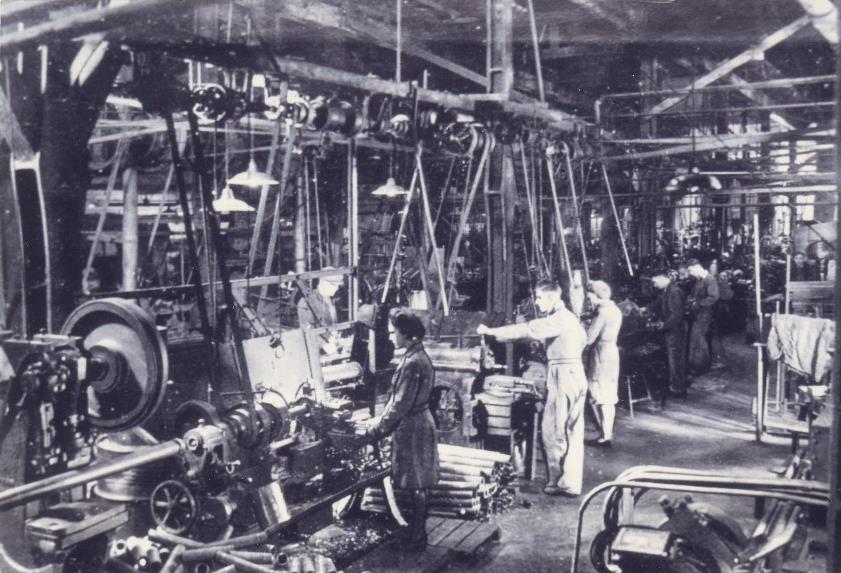

Factory workers at Armstrongs c.1940s (archive ref DDPD-2-2-6)
This week’s image is of the factory workers at Armstrong Patents Limited circa 1940, at the Beverley factory site between Eastgate and Station Square. The company’s founder was mechanical engineer and inventor, Gordon Armstrong who, in 1935, formed the Armstrong Patents Company Ltd for shock absorbers. Having patented the original idea for efficient shock absorbers on motor vehicles, Gordon Armstrong made a huge contribution to the motor industry with his invention, providing a vast improvement in passenger comfort. In 1907 he opened his first garage in Tiger Lane and by 1927 the shock absorber had been adopted by one of the largest motor car manufacturers in England. By the 1930s the company really began to flourish, and Armstrong also opened a garage and engineering works based in Hull, offering a twenty four hour service. The Beverley factory was demolished during the 1970s and the site re-developed as housing. (Why not try searching our for more historic images? (Copyright) We're happy for you to share this digital image within the spirit of Creative Commons. Please cite ' ' when reusing. Certain restrictions on high quality reproductions and commercial use of the original phys
- Date
- 2016
- Photographer / author
- East Riding Archives
- Archive
- Wikimedia Commons
- Type
- photograph
- Original size
- 841 × 573 pixels
CC0safest
Reason: CC0: dedicated to the public domain.
Read from: Commons licence category: CC-Zero; no CC BY, CC BY-SA, GFDL or deletion tag on the file page.
Credit line
"Factory workers at Armstrongs c.1940s (archive ref DDPD-2-2-6)" (2016). East Riding Archives, via Wikimedia Commons. CC0. https://commons.wikimedia.org/wiki/File:Factory_workers_at_Armstrongs_c.1940s_(archive_ref_DDPD-2-2-6)_(30261046665).jpgNeed photos for a whole script? Add Find Any Photo to Claude and ask for this one by its id: 115205.
More like this

Swedish-American foreman and workers at the SKF roller bearing factory 8d27961v
1942–1943 · Library of Congress

Swedish-American foreman and workers at the SKF roller bearing factory 8d27959v
1942–1943 · Library of Congress

Safe clothes for women war workers. Correctly dressed, correctly coiffed and ready for work, Eunice Kimball shows her new safety uniform and hair-do to Bendix's chief inspector, Walter Rodgers, who thoroughly approves the transformation. In compliance with all safety rules, her uniform is also smart
1943-03 · Library of Congress

Photo shows Aluminum Industries, Inc., Cincinnati, Ohio.
1942-02 · Library of Congress

Workers at a new bomber production plant
c. 1942 · U.S. National Archives

Conversion. Watch cases to war production. They'll be doing war work soon. When the last batch of ladies' compacts is cleaned at a converted Kentucky plant, these girls will use their skill in the prduction of bomb fuse baffles, compass cases and parts for carbine and machine guns. Wadsworth Watch C
1942-02 · Wikimedia Commons

A part of the shop in a Midwestern company which has converted its machines and trained labor forces
1942 · Wikimedia Commons

Thousands of North American employees came through those gates at the Inglewood, Calif., plant each day. Employees must display their badges and identification cards before admittance.
c. 1942 · U.S. National Archives