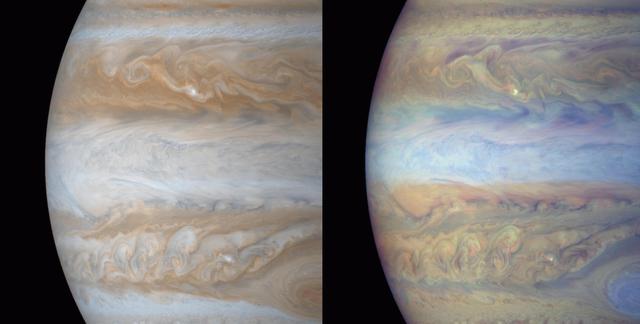
Jupiter in True and False Color
These color composite frames of the mid-section of Jupiter were of narrow angle images acquired on December 31, 2000, a day after Cassini's closest approach to the planet. The smallest features in these frames are roughly ~ 60 kilometers. The left is natural color, composited to yield the color that Jupiter would have if seen by the naked eye. The right frame is composed of 3 images: two were taken through narrow band filters centered on regions of the spectrum where the gaseous methane in Jupiter's atmosphere absorbs light, and the third was taken in a red continuum region of the spectrum, where Jupiter has no absorptions. The combination yields an image whose colors denote the height of the clouds. Red regions are deep water clouds, bright blue regions are high haze (like the blue covering the Great Red Spot). Small, intensely bright white spots are energetic lightning storms which have penetrated high into the atmosphere where there is no opportunity for absorption of light: these high cloud systems reflect all light equally. The darkest blue regions -- for example, the long linear regions which border the northern part of the equatorial zone, are the very deep "hot spots', seen
- Date
- 2001-01-23
- Photographer / author
- NASA/JPL/University of Arizona
- Collection
- JPL
- Archive
- NASA Image and Video Library
- Type
- photograph
Public domainsafest
Reason: a NASA work: not copyrighted in the United States.
Read from: NASA media usage guidelines: NASA material is not copyrighted in the US unless noted; no third-party credit or mark found.
Credit line
"Jupiter in True and False Color" (2001-01-23). NASA/JPL/NASA/JPL/University of Arizona. Public domain. https://images.nasa.gov/details/PIA02877Need photos for a whole script? Add Find Any Photo to Claude and ask for this one by its id: 22009.
More like this

Atmospheric Motion in Jupiter Northern Hemisphere
2000-09-25 · NASA Image and Video Library

Nine Frames as Jupiter Turns
2000-11-06 · NASA Image and Video Library

Jupiter Clouds in Depth
2000-12-29 · NASA Image and Video Library
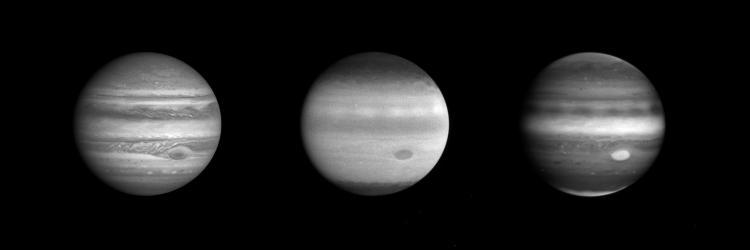
Jupiter in blue, ultraviolet and Near Infrared
2000-10-23 · NASA Image and Video Library
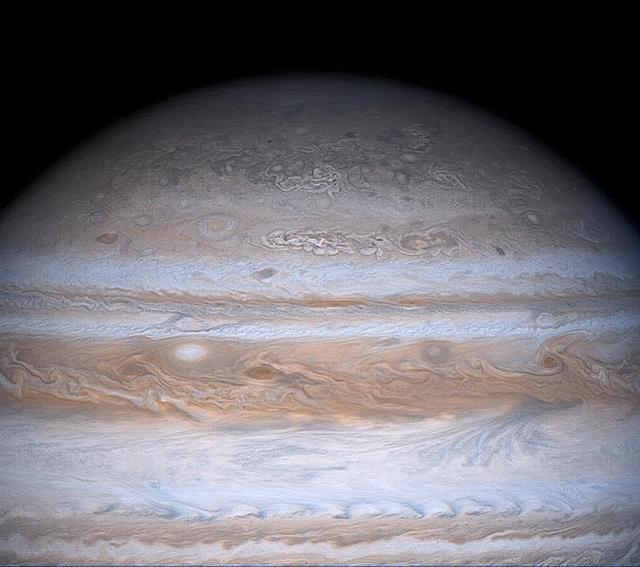
High Latitude Mottling on Jupiter
2000-12-19 · NASA Image and Video Library
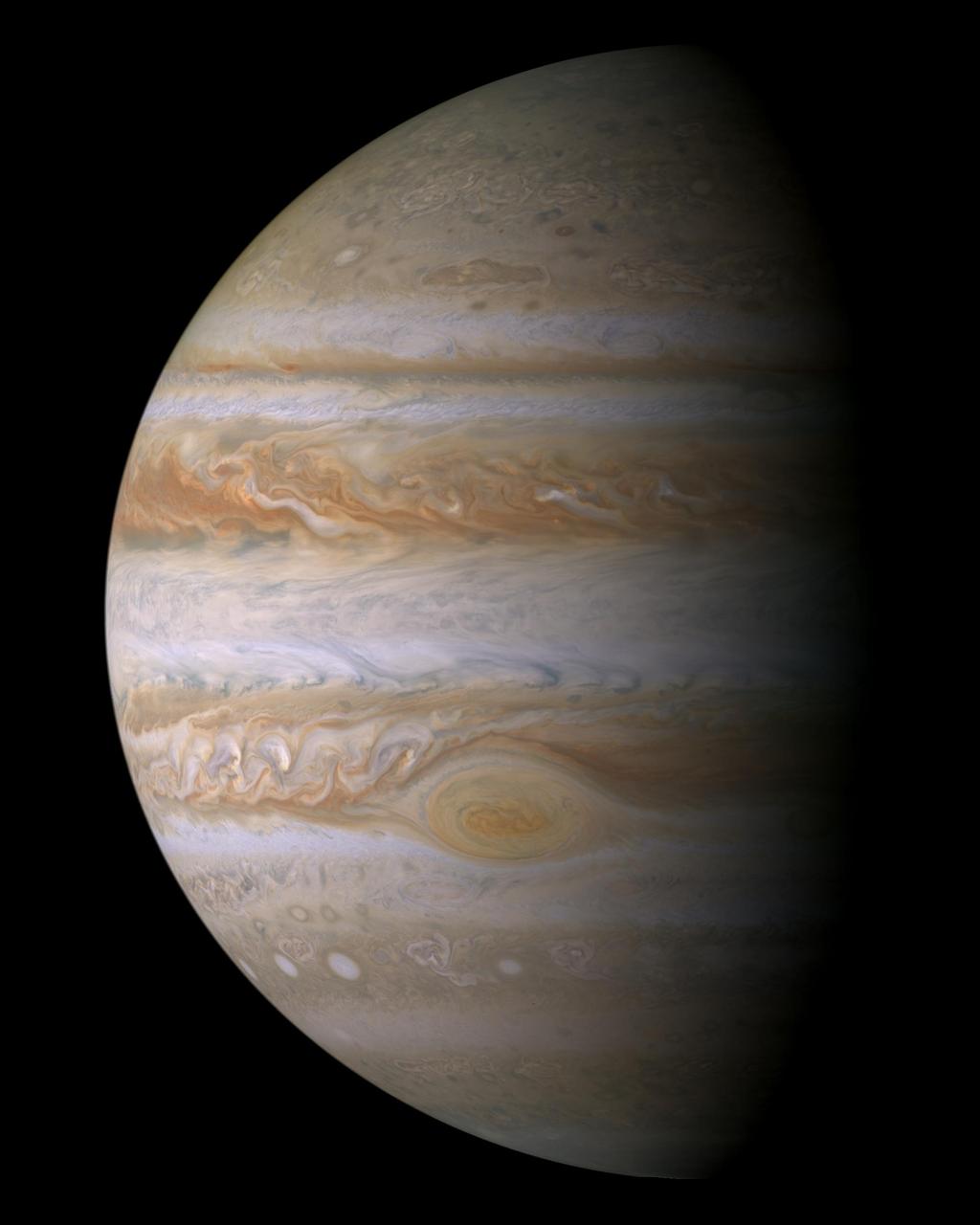
Cassini Jupiter Portrait
2003-11-13 · NASA Image and Video Library
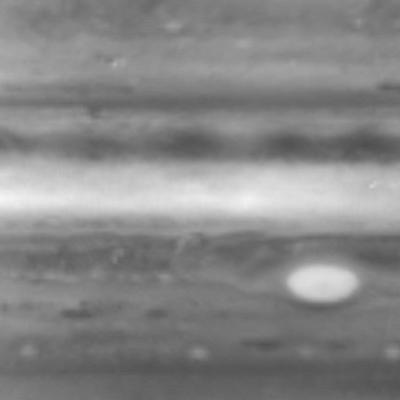
Still from High-Clouds Jupiter Movie
2000-12-12 · NASA Image and Video Library
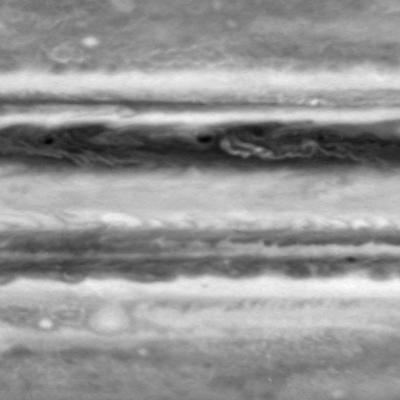
Still from Processed Movie of Zonal Jets
2000-11-21 · NASA Image and Video Library