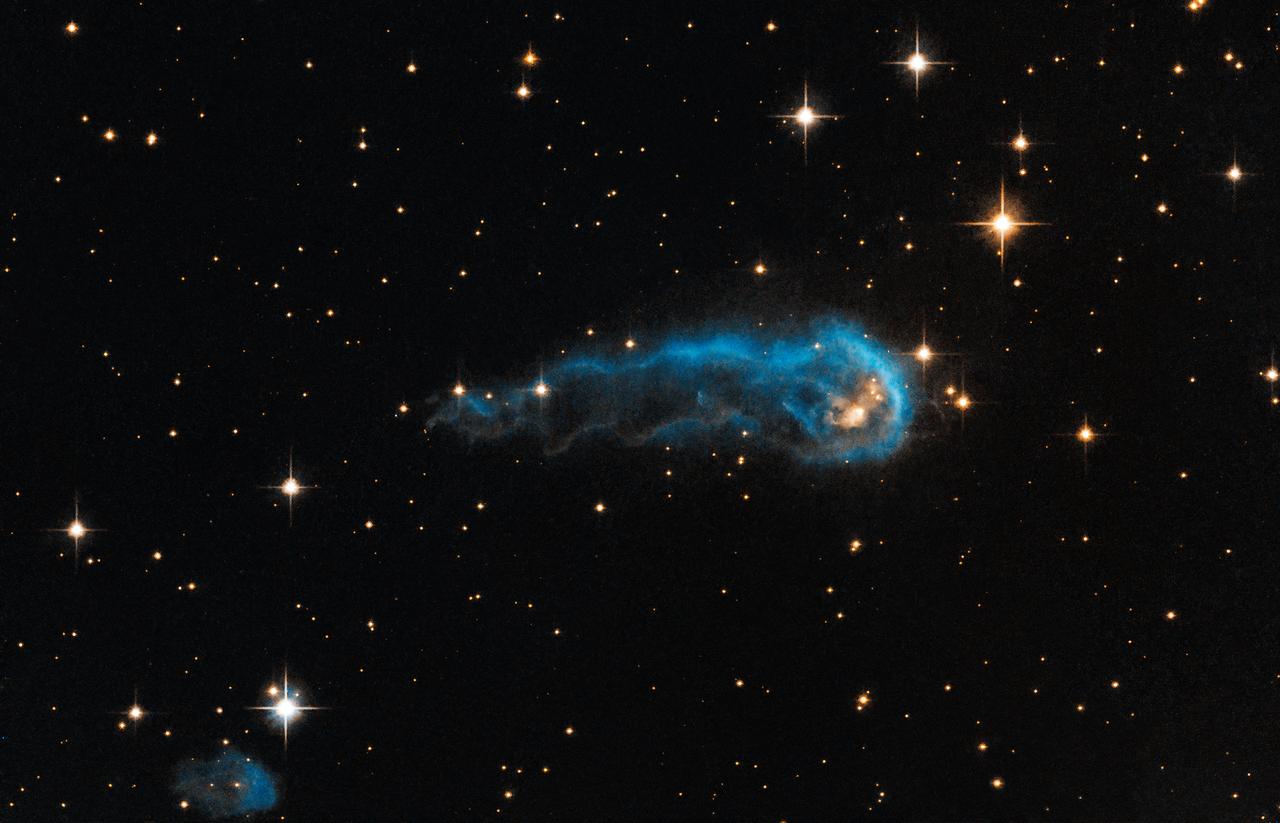
NASA’s Hubble Sees a Cosmic Caterpillar
This light-year-long knot of interstellar gas and dust resembles a caterpillar on its way to a feast. But the meat of the story is not only what this cosmic caterpillar eats for lunch, but also what's eating it. Harsh winds from extremely bright stars are blasting ultraviolet radiation at this "wanna-be" star and sculpting the gas and dust into its long shape. The culprits are 65 of the hottest, brightest known stars, classified as O-type stars, located 15 light-years away from the knot, towards the right edge of the image. These stars, along with 500 less bright, but still highly luminous B-type stars make up what is called the Cygnus OB2 association. Collectively, the association is thought to have a mass more than 30,000 times that of our sun. The caterpillar-shaped knot, called IRAS 20324+4057, is a protostar in a very early evolutionary stage. It is still in the process of collecting material from an envelope of gas surrounding it. However, that envelope is being eroded by the radiation from Cygnus OB2. Protostars in this region should eventually become young stars with final masses about one to ten times that of our sun, but if the eroding radiation from the nearby
- Date
- 2017-12-08
- Collection
- GSFC
- Archive
- NASA Image and Video Library
- Type
- photograph
Public domainsafest
Reason: a NASA work: not copyrighted in the United States.
Read from: NASA media usage guidelines: NASA material is not copyrighted in the US unless noted; no third-party credit or mark found.
Credit line
"NASA’s Hubble Sees a Cosmic Caterpillar" (2017-12-08). NASA/GSFC. Public domain. https://images.nasa.gov/details/GSFC_20171208_Archive_e001397Need photos for a whole script? Add Find Any Photo to Claude and ask for this one by its id: 17533.
More like this
Hubble Captures Cosmic Ice Sculptures
2017-12-08 · NASA Image and Video Library
Hubble Sees a Stellar "Sneezing Fit"
2017-12-08 · NASA Image and Video Library
Hubble Uncovering the Secrets of the Quintuplet Cluster
2017-12-08 · NASA Image and Video Library

Hubble Captures Spectacular "Landscape" in the Carina Nebula
2017-12-08 · NASA Image and Video Library

Hubble Sees a Star ‘Inflating’ a Giant Bubble
2017-12-08 · NASA Image and Video Library
hs-2007-16-e-full_jpg
2017-12-08 · NASA Image and Video Library

Hubble Sees the Force Awakening in a Newborn Star
2017-12-08 · NASA Image and Video Library
Hubble Observes One-of-a-Kind Star Nicknamed ‘Nasty’
2017-12-08 · NASA Image and Video Library