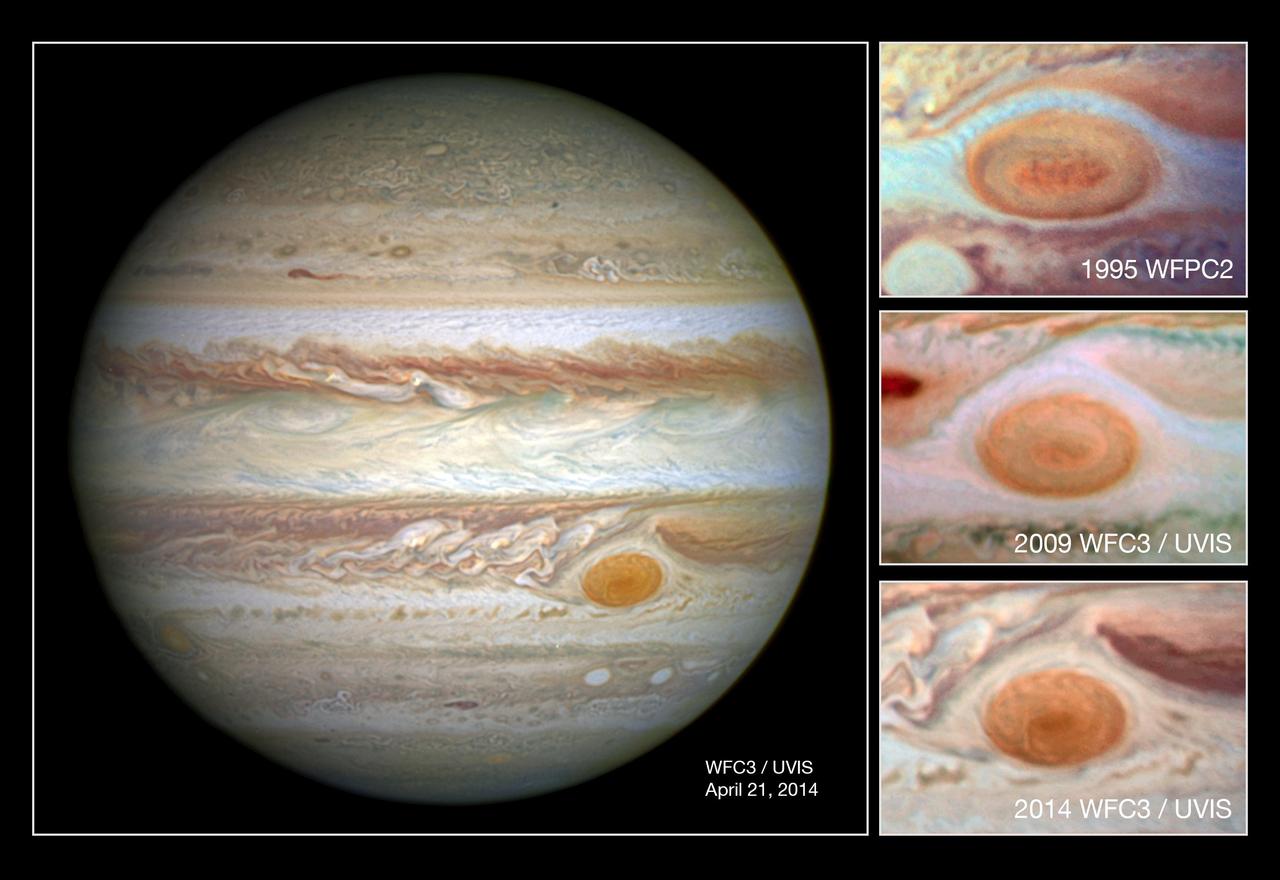
NASA's Hubble Shows Jupiter's Great Red Spot is Smaller than Ever
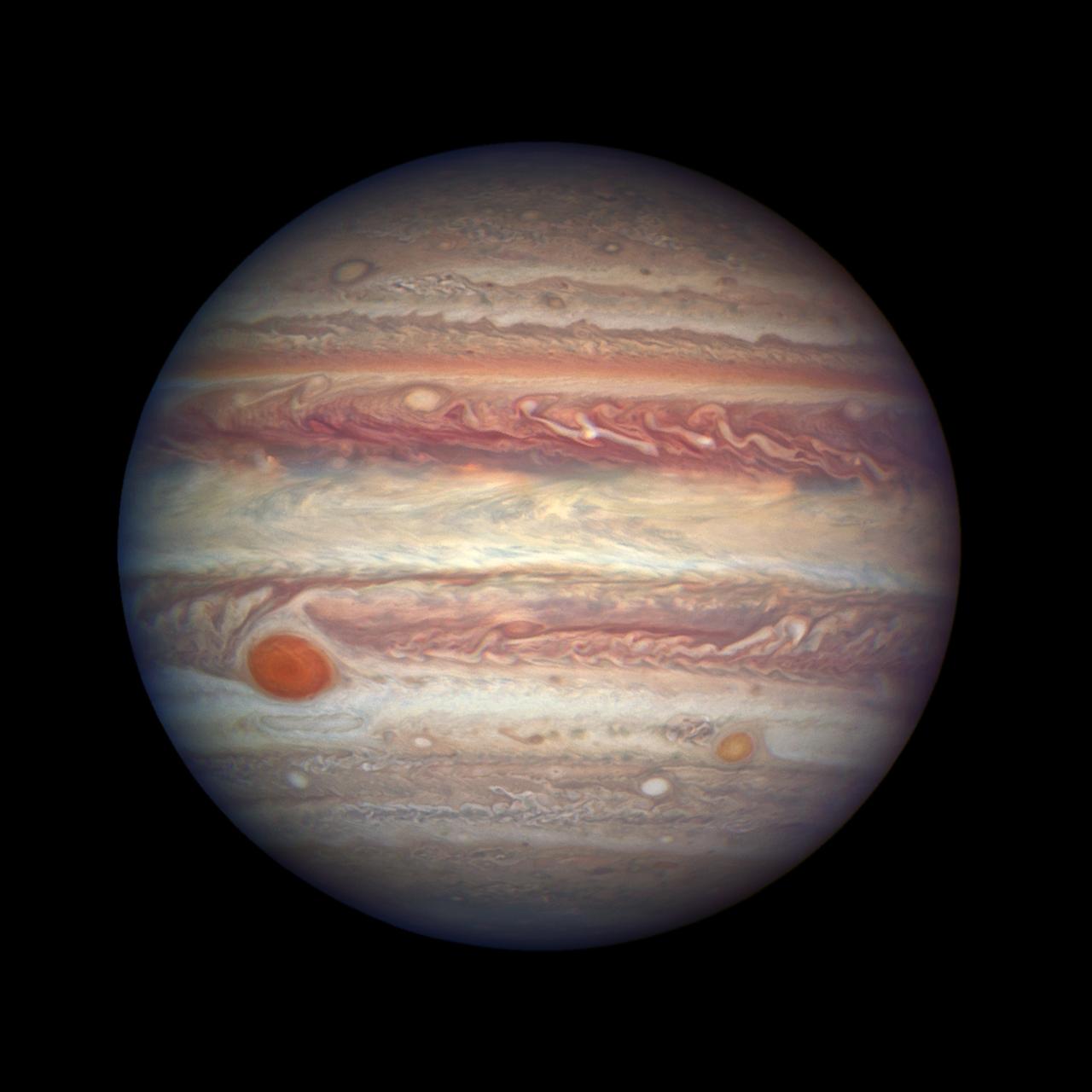
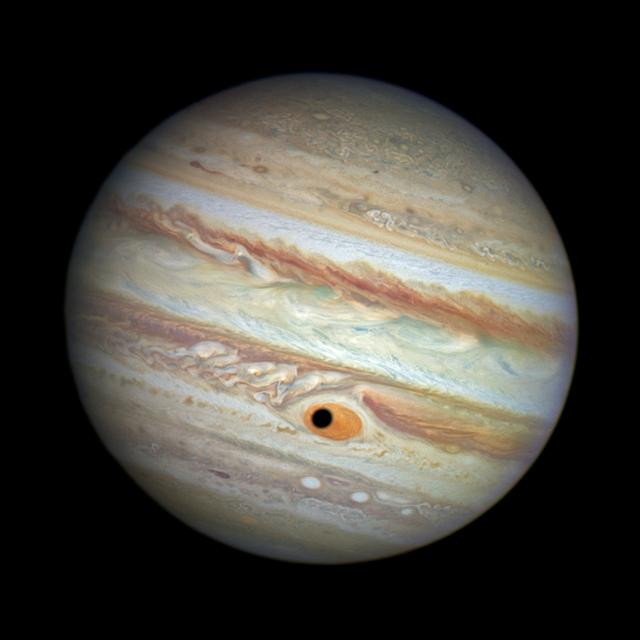
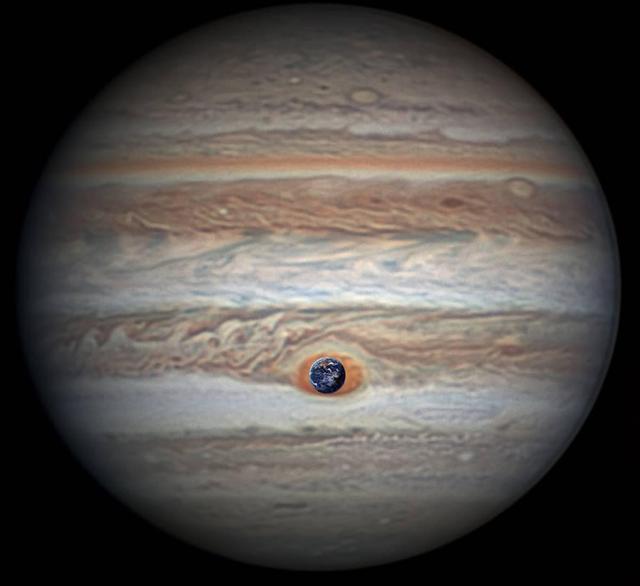
In this comparison image the photo at the top was taken by Hubble's Wide Field Planetary Camera 2 in 1995 and shows the spot at a diameter of just under 21 000km; the second down shows a 2009 WFC3 photo of the spot at a diameter of just under 18 000km; and the lowest shows the newest image from WFC3 taken in 2014 with the spot at its smallest yet, with diameter of just 16 000km. -- Jupiter's trademark Great Red Spot -- a swirling anti-cyclonic storm larger than Earth -- has shrunk to its smallest size ever measured. According to Amy Simon of NASA's Goddard Space Flight Center in Greenbelt, Maryland, recent NASA Hubble Space Telescope observations confirm the Great Red Spot now is approximately 10,250 miles across. Astronomers have followed this downsizing since the 1930s. Historic observations as far back as the late 1800s gauged the storm to be as large as 25,500 miles on its long axis. NASA Voyager 1 and Voyager 2 flybys of Jupiter in 1979 measured it to be 14,500 miles across. In 1995, a Hubble photo showed the long axis of the spot at an estimated 13,020 miles across. And in a 2009 photo, it was measured at 11,130 miles across. Beginning in 2012, amateur observations revealed a
- Date
- 2017-12-08
- Collection
- GSFC
- Archive
- NASA Image and Video Library
- Type
- photograph
Public domainsafest
Reason: a NASA work: not copyrighted in the United States.
Read from: NASA media usage guidelines: NASA material is not copyrighted in the US unless noted; no third-party credit or mark found.
Credit line
"NASA's Hubble Shows Jupiter's Great Red Spot is Smaller than Ever" (2017-12-08). NASA/GSFC. Public domain. https://images.nasa.gov/details/GSFC_20171208_Archive_e001093Need photos for a whole script? Add Find Any Photo to Claude and ask for this one by its id: 17672.
More like this
NASA's Hubble Shows Jupiter's Great Red Spot is Smaller than Ever
2017-12-08 · NASA Image and Video Library
NASA's Hubble Shows Jupiter's Great Red Spot is Smaller than Ever
2017-12-08 · NASA Image and Video Library

Hubble’s Planetary Portrait Captures New Changes in Jupiter’s Great Red Spot
2017-12-08 · NASA Image and Video Library
Hubble Spies Spooky Shadow on Jupiter's Giant Eye
2017-12-08 · NASA Image and Video Library
NASA's Hubble Takes Close-up Portrait of Jupiter
2017-12-08 · NASA Image and Video Library
Hubble Spies Spooky Shadow on Jupiter's Giant Eye (color)
2017-12-08 · NASA Image and Video Library
Dynamics of Jupiter's Great Red Spot in the Near-infrared
1997-11-04 · NASA Image and Video Library
PIA21774
2017-07-11 · NASA Image and Video Library