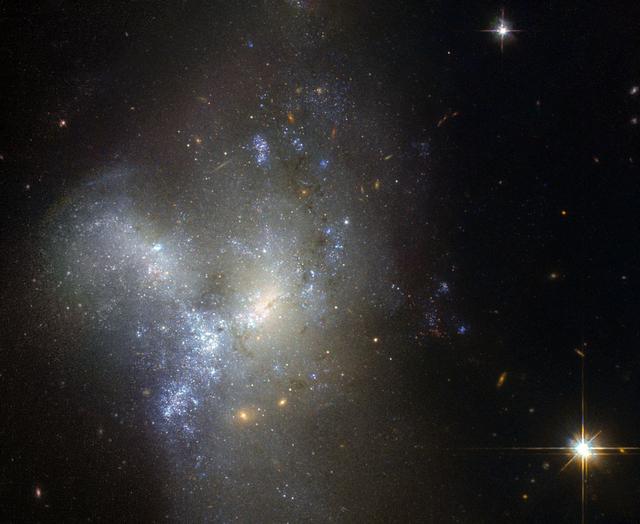
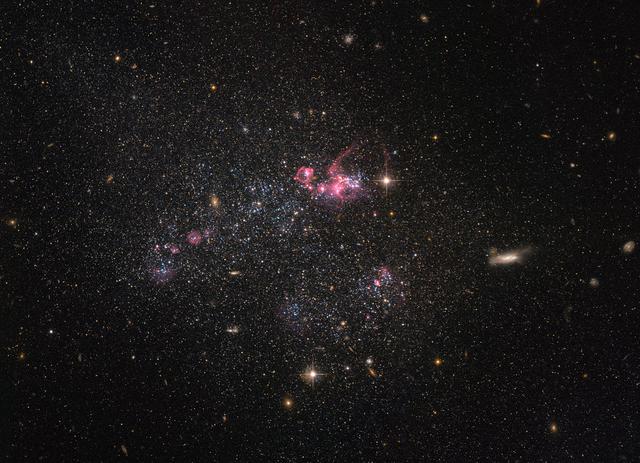
One from many
This image, taken by the NASA/ESA Hubble Space Telescope, shows a peculiar galaxy known as NGC 1487, lying about 30 million light-years away in the southern constellation of Eridanus. Rather than viewing a celestial object, it is actually better to think of this as an event. Here, we are witnessing two or more galaxies in the act of merging together to form a single new galaxy. Each progenitor has lost almost all traces of its original appearance, as stars and gas have been thrown hither and thither by gravity in an elaborate cosmic whirl. Unless one is very much bigger than the other, galaxies are always disrupted by the violence of the merging process. As a result, it is very difficult to determine precisely what the original galaxies looked like and, indeed, how many of them there were. In this case, it is possible that we are seeing the merger of several dwarf galaxies that were previously clumped together in a small group. Although older yellow and red stars can be seen in the outer regions of the new galaxy, its appearance is dominated by large areas of bright blue stars, illuminating the patches of gas that gave them life. This burst of star formation may well have been trig
- Date
- 2016-02-01
- Collection
- GSFC
- Archive
- NASA Image and Video Library
- Type
- photograph
Public domainsafest
Reason: a NASA work: not copyrighted in the United States.
Read from: NASA media usage guidelines: NASA material is not copyrighted in the US unless noted; no third-party credit or mark found.
Credit line
"One from many" (2016-02-01). NASA/GSFC. Public domain. https://images.nasa.gov/details/30-million-light-years-away-hubble-sees-merging-galaxies_24715543202_oNeed photos for a whole script? Add Find Any Photo to Claude and ask for this one by its id: 16303.
More like this
Two become one
2015-12-28 · NASA Image and Video Library
A galactic mega-merger
2016-01-11 · NASA Image and Video Library
Rebel rebel
2016-01-18 · NASA Image and Video Library
A galactic nursery
2015-07-20 · NASA Image and Video Library
Hubble Sees NGC 3447: 2 Galaxies in a Cosmic Dance Defy Conventions
2017-12-08 · NASA Image and Video Library
Hubble Catches a Galaxy Duo by the "Hare"
2017-12-08 · NASA Image and Video Library
Intense and short-lived
2015-06-29 · NASA Image and Video Library
A distinctly disorganised dwarf
2016-03-28 · NASA Image and Video Library