Space Science
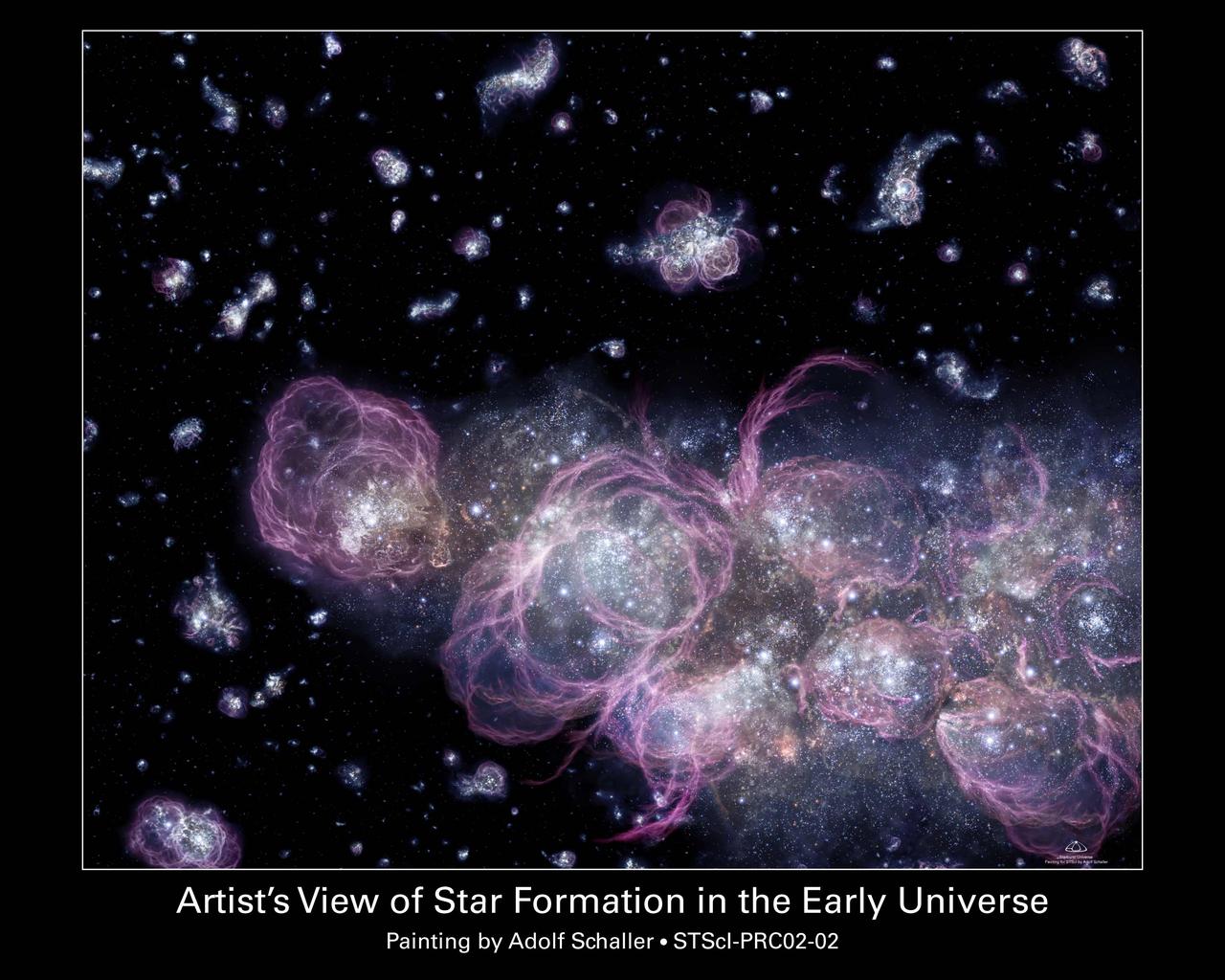
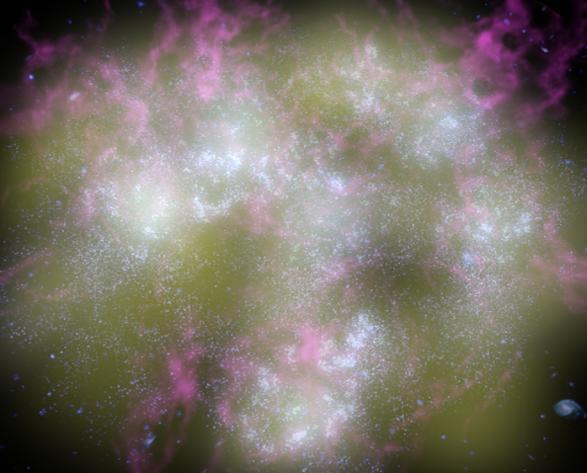
This is an artist's impression of how the very early universe (less than one billion years old) might have looked when it went through a voracious onset of star formation, converting primordial hydrogen into myriad stars at an unprecedented rate. The deepest views of the cosmos from the Hubble Space Telescope (HST) yield clues that the very first stars may have burst into the universe as brilliantly and spectacularly as a firework finale. Except in this case, the finale came first, long before Earth, the Sun,and the Milky Way Galaxy formed. Studies of HST's deepest views of the heavens lead to the preliminary conclusion that the universe made a significant portion of its stars in a torrential firestorm of star birth, which abruptly lit up the pitch-dark heavens just a few hundred million years after the "big bang," the tremendous explosion that created the cosmos. Within the starburst galaxies, bright knots of hot blue stars come and go like bursting fireworks shells. Regions of new starbirth glow intensely red under torrent of ultraviolet radiation. The most massive stars self-detonate as supernovas, which explode across the sky like a string of firecrackers. A foreground starbur
- Date
- 2002-01-01
- Collection
- MSFC
- Archive
- NASA Image and Video Library
- Type
- illustration (NASA artwork)
Public domainsafest
Reason: a NASA work: not copyrighted in the United States.
Read from: NASA media usage guidelines: NASA material is not copyrighted in the US unless noted; no third-party credit or mark found.
Credit line
"Space Science" (2002-01-01). NASA/MSFC. Public domain. https://images.nasa.gov/details/0203045Need photos for a whole script? Add Find Any Photo to Claude and ask for this one by its id: 16645.
More like this
Stars Spring up Out of the Darkness Artist Concept
2006-12-18 · NASA Image and Video Library
Baby Galaxies in the Adult Universe
2004-12-21 · NASA Image and Video Library

A Cauldron of Star Birth in the Center of a Young Galaxy Artist Concept
2014-08-27 · NASA Image and Video Library
At the Heart of Blobs Artist Concept
2005-01-11 · NASA Image and Video Library

Hubble Deep Field Image Unveils Myriad Galaxies Back to the Beginning of Time
1996-01-15 · NASA Image and Video Library

History of Hubble Space Telescope (HST)
1995-12-01 · NASA Image and Video Library
Fires of Galactic Youth Artist Animation
2004-12-22 · NASA Image and Video Library
Distant Galaxy Bursts with Stars
2011-12-21 · NASA Image and Video Library