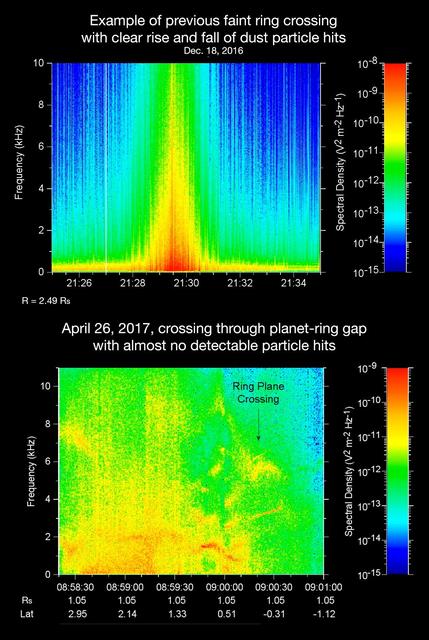
The Sound of Science: Comparison of Cassini Ring Crossings
The sounds and spectrograms in these two videos represent data collected by the Radio and Plasma Wave Science, or RPWS, instrument on NASA's Cassini spacecraft, as it crossed the plane of Saturn's rings on two separate orbits. As tiny, dust-sized particles strike Cassini and the three 33-foot-long (10-meter-long), RPWS antennas, the particles are vaporized into tiny clouds of plasma, or electrically excited gas. These tiny explosions make a small electrical signal (a voltage impulse) that RPWS can detect. Researchers on the RPWS team convert the data into visible and audio formats, like those seen here, for analysis. Ring particle hits sound like pops and cracks in the audio. The first video (top image in the montage) was made using RPWS data from a ring plane crossing on Dec. 18, 2016, when the spacecraft passed through the faint, dusty Janus-Epimetheus ring (see PIA08328 for an image that features this ring). This was during Cassini's 253rd orbit of Saturn, known as Rev 253. As is typical for this sort of ring crossing, the number of audible pops and cracks rises to a maximum around the time of a ring crossing and trails off afterward. The peak of the ring density is obvious in t
- Date
- 2017-05-01
- Photographer / author
- NASA/JPL-Caltech/University of Iowa
- Collection
- JPL
- Archive
- NASA Image and Video Library
- Type
- photograph
Public domainsafest
Reason: a NASA work: not copyrighted in the United States.
Read from: NASA media usage guidelines: NASA material is not copyrighted in the US unless noted; no third-party credit or mark found.
Credit line
"The Sound of Science: Comparison of Cassini Ring Crossings" (2017-05-01). NASA/JPL/NASA/JPL-Caltech/University of Iowa. Public domain. https://images.nasa.gov/details/PIA21446Need photos for a whole script? Add Find Any Photo to Claude and ask for this one by its id: 84717.
More like this
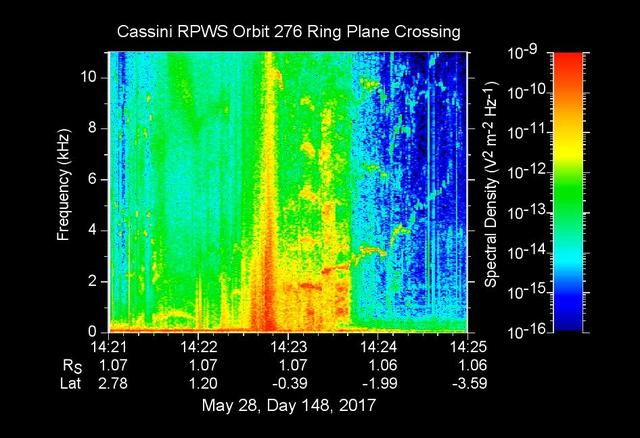
Cassini's First D-Ring Crossing
2017-07-24 · NASA Image and Video Library
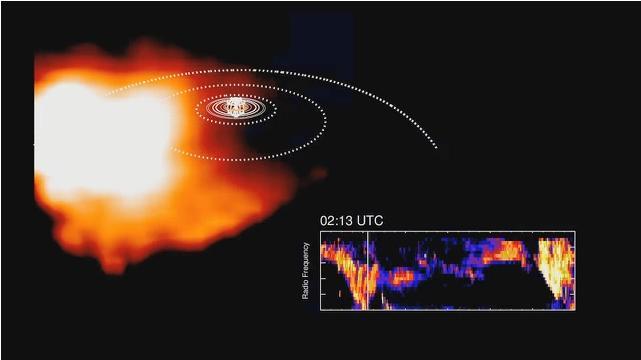
Saturn Plasma and Radio Waves, as Seen by Cassini
2010-12-14 · NASA Image and Video Library
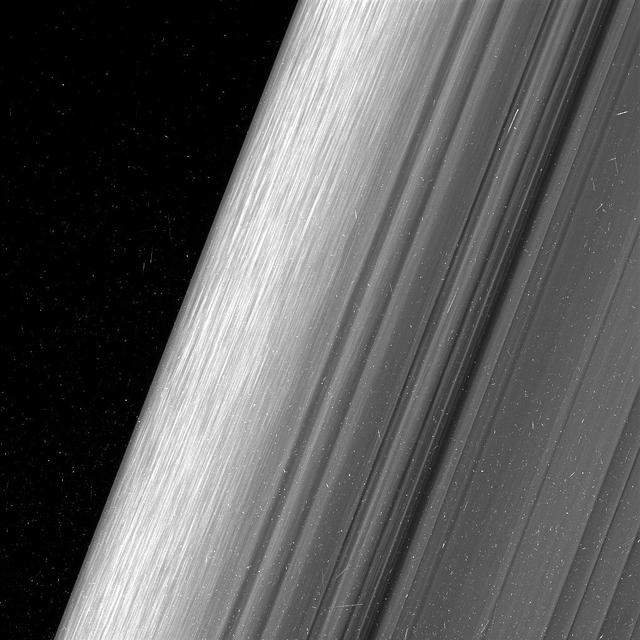
Straw in the B Ring Edge
2017-01-30 · NASA Image and Video Library
The Propeller Belts in Saturn A Ring
2017-01-30 · NASA Image and Video Library
Cassini's 'Inside-Out' Rings
2017-08-25 · NASA Image and Video Library
Saturn B Ring, Finer Than Ever
2017-01-30 · NASA Image and Video Library

Hardy Objects in Saturn F Ring
2017-02-24 · NASA Image and Video Library
Galactic Behavior for the Outer B Ring
2010-11-01 · NASA Image and Video Library