
The Tarantula Nebula
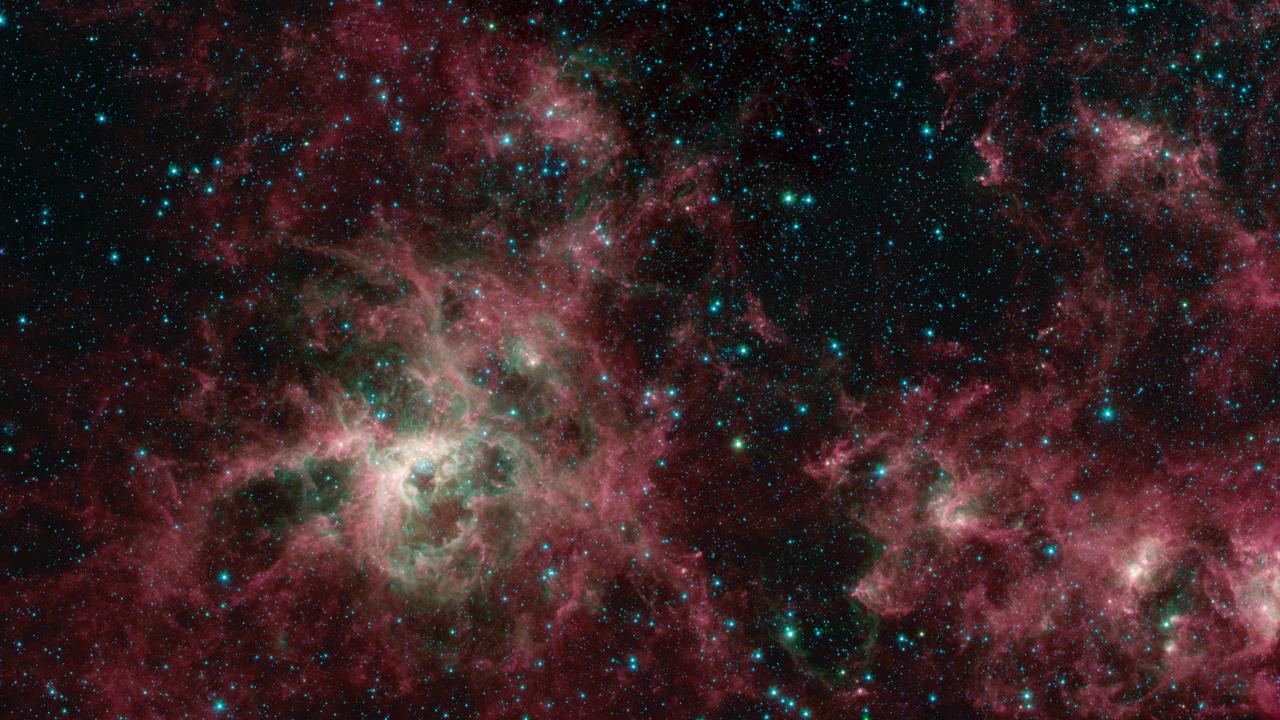
NASA Spitzer Space Telescope, formerly known as the Space Infrared Telescope Facility, has captured in stunning detail the spidery filaments and newborn stars of theTarantula Nebula, a rich star-forming region also known as 30 Doradus. This cloud of glowing dust and gas is located in the Large Magellanic Cloud, the nearest galaxy to our own Milky Way, and is visible primarily from the Southern Hemisphere. This image of an interstellar cauldron provides a snapshot of the complex physical processes and chemistry that govern the birth - and death - of stars. At the heart of the nebula is a compact cluster of stars, known as R136, which contains very massive and young stars. The brightest of these blue supergiant stars are up to 100 times more massive than the Sun, and are at least 100,000 times more luminous. These stars will live fast and die young, at least by astronomical standards, exhausting their nuclear fuel in a few million years. The Spitzer Space Telescope image was obtained with an infrared array camera that is sensitive to invisible infrared light at wavelengths that are about ten times longer than visible light. In this four-color composite, emission at 3.6 microns is dep
- Date
- 2004-01-13
- Photographer / author
- NASA/JPL-Caltech/Cornell University and University of Leiden
- Collection
- JPL
- Archive
- NASA Image and Video Library
- Type
- photograph
Public domainsafest
Reason: a NASA work: not copyrighted in the United States.
Read from: NASA media usage guidelines: NASA material is not copyrighted in the US unless noted; no third-party credit or mark found.
Credit line
"The Tarantula Nebula" (2004-01-13). NASA/JPL/NASA/JPL-Caltech/Cornell University and University of Leiden. Public domain. https://images.nasa.gov/details/PIA05062Need photos for a whole script? Add Find Any Photo to Claude and ask for this one by its id: 17158.
More like this

WISE Spies the Tarantula Nebula
2010-07-06 · NASA Image and Video Library

A New View of the Tarantula Nebula
2012-04-17 · NASA Image and Video Library

Tarantula Nebula Spitzer 2-Color Image
2020-01-27 · NASA Image and Video Library
Tarantula Nebula Spitzer 3-Color Image
2020-01-27 · NASA Image and Video Library

30 Doradus: The Growing Tarantula Within
2011-11-16 · NASA Image and Video Library
What Old is New in the Large Magellanic Cloud
2006-09-01 · NASA Image and Video Library
Our Chaotic Neighbor
2006-09-01 · NASA Image and Video Library

Star Formation in Henize 206
2004-03-08 · NASA Image and Video Library