History of Hubble Space Telescope (HST)
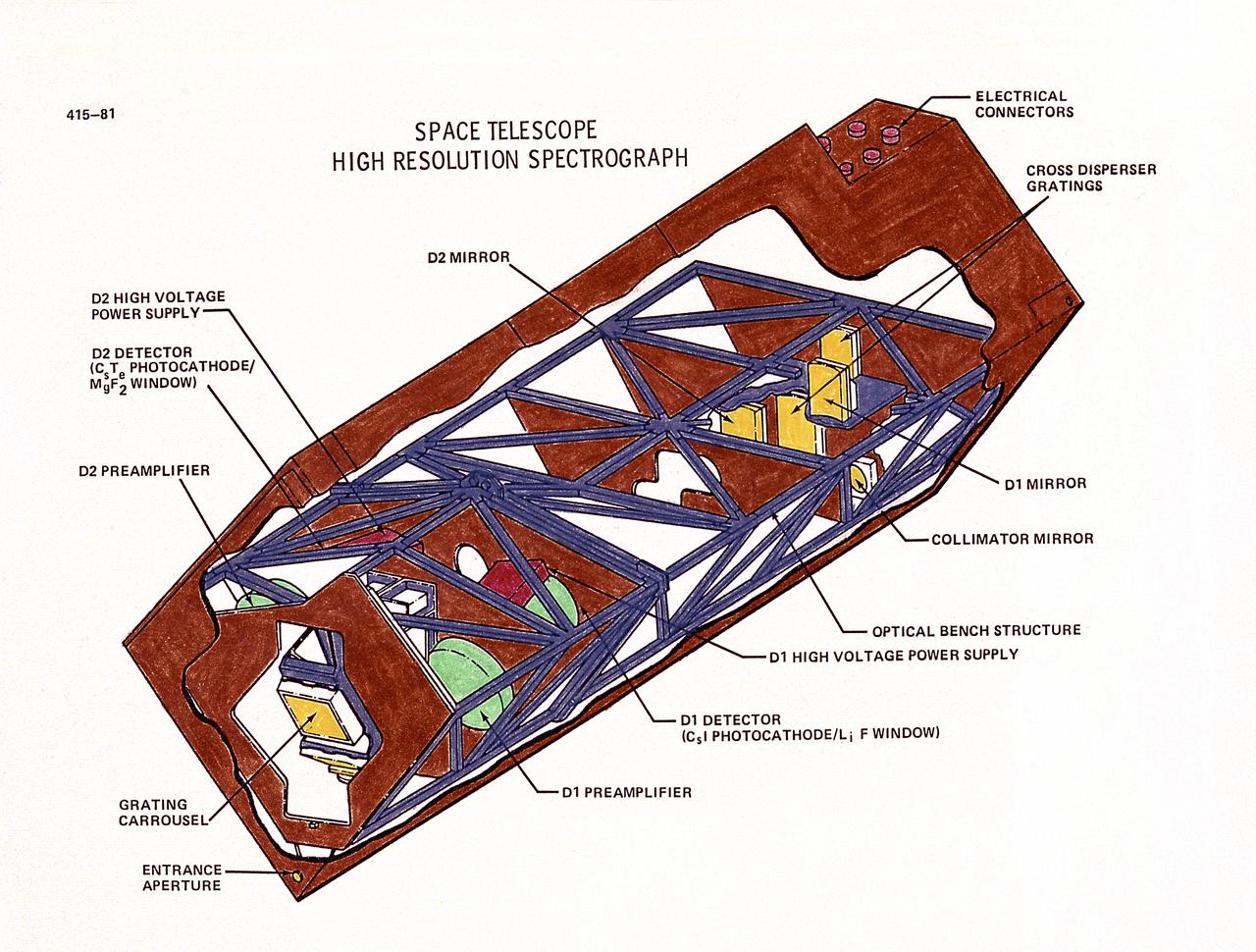
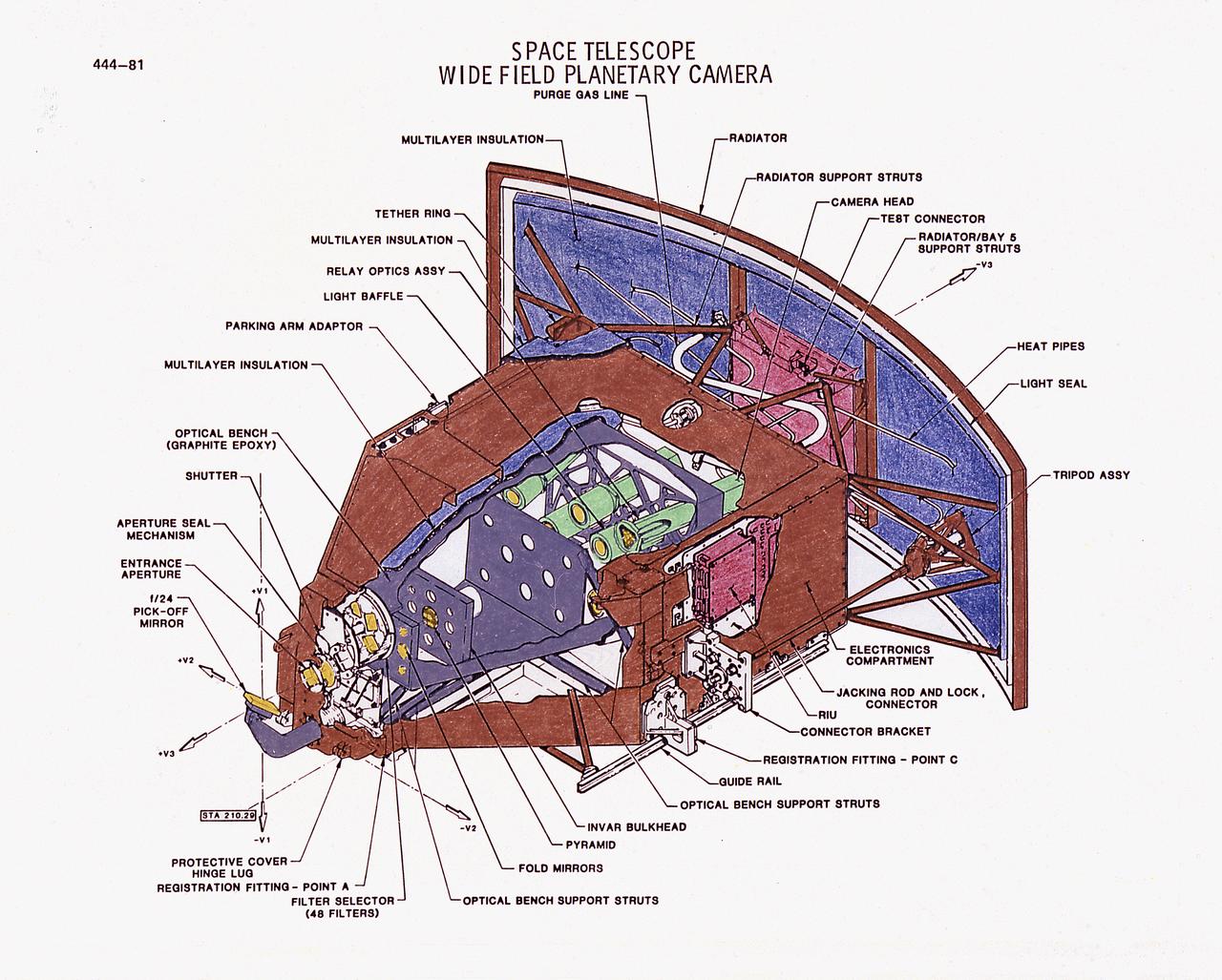
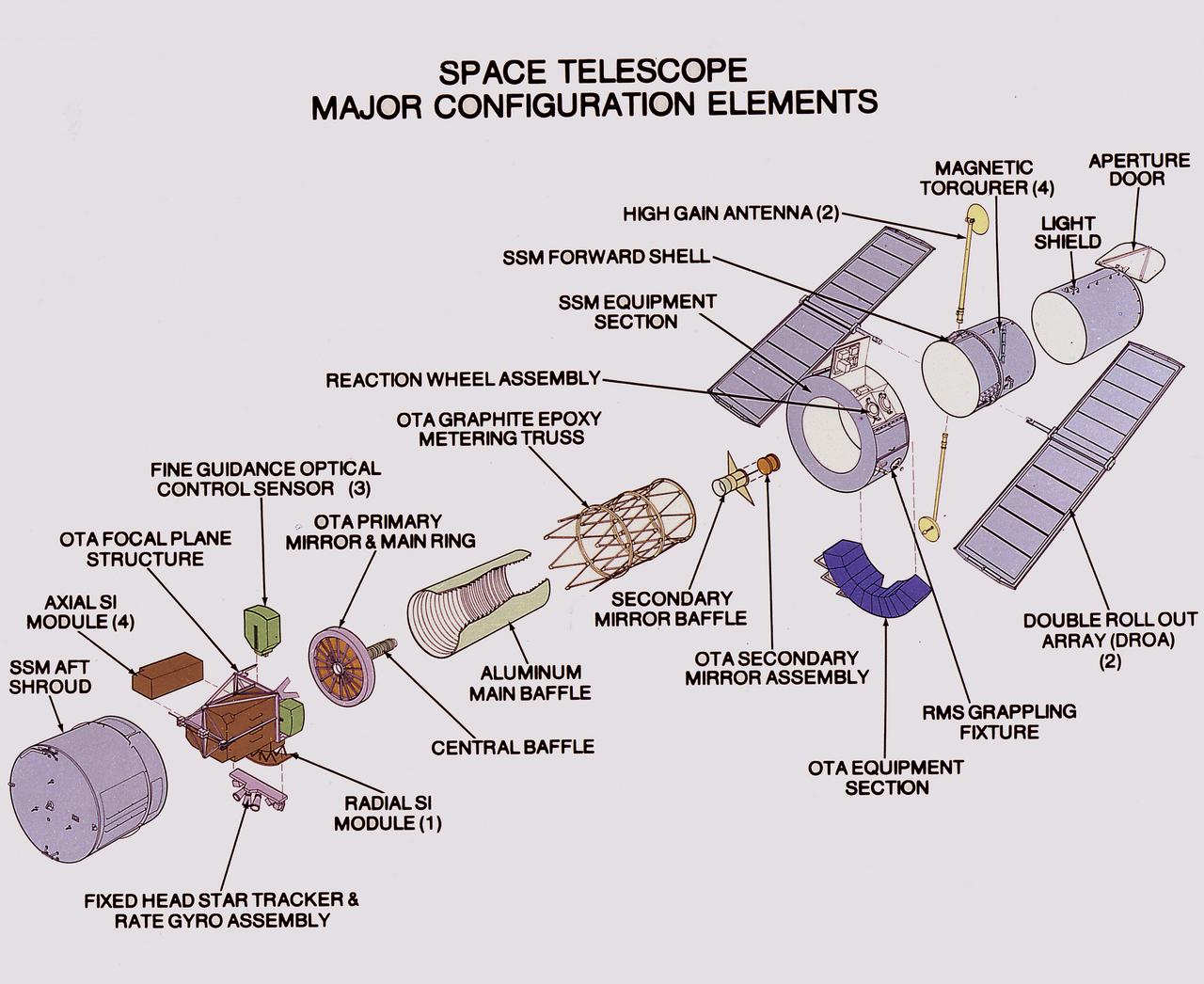
This drawing illustrates the Hubble Space Telescope's (HST's), Goddard High-Resolution Spectrograph (GHRS). The HST's two spectrographs, the GHRS and the Faint Object Spectrograph (FOS), can detect a broader range of wavelengths than is possible from Earth because there is no atmosphere to absorb certain wavelengths. Scientists can determine the chemical composition, temperature, pressure, and turbulence of the stellar atmosphere producing the light, all from spectral data. The GHRS can detect fine details in the light from somewhat brighter objects but only ultraviolet light. Both spectrographs operate in essentially the same way. The incoming light passes through a small entrance aperture, then passes through filters and diffraction gratings, that work like prisms. The filter or grating used determines what range of wavelength will be examined and in what detail. Then the spectrograph detectors record the strength of each wavelength band and sends it back to Earth. The purpose of the HST, the most complex and sensitive optical telescope ever made, is to study the cosmos from a low-Earth orbit. By placing the telescope in space, astronomers are able to collect data that is free of
- Date
- 1981-01-01
- Collection
- MSFC
- Archive
- NASA Image and Video Library
- Type
- photograph
Public domainsafest
Reason: a NASA work: not copyrighted in the United States.
Read from: NASA media usage guidelines: NASA material is not copyrighted in the US unless noted; no third-party credit or mark found.
Credit line
"History of Hubble Space Telescope (HST)" (1981-01-01). NASA/MSFC. Public domain. https://images.nasa.gov/details/8113712Need photos for a whole script? Add Find Any Photo to Claude and ask for this one by its id: 17683.
More like this
History of Hubble Space Telescope (HST)
1981-01-01 · NASA Image and Video Library
History of Hubble Space Telescope (HST)
1981-01-01 · NASA Image and Video Library
History of Hubble Space Telescope (HST)
1981-01-01 · NASA Image and Video Library
History of Hubble Space Telescope (HST)
1981-01-01 · NASA Image and Video Library
History of Hubble Space Telescope (HST)
1980-01-01 · NASA Image and Video Library

History of Hubble Space Telescope (HST)
1980-10-01 · NASA Image and Video Library
History of Hubble Space Telescope (HST)
1989-01-01 · NASA Image and Video Library
Artist concept of Hubble Space Telescope (HST) orbiting Earth after deploy
1990-04-05 · NASA Image and Video Library