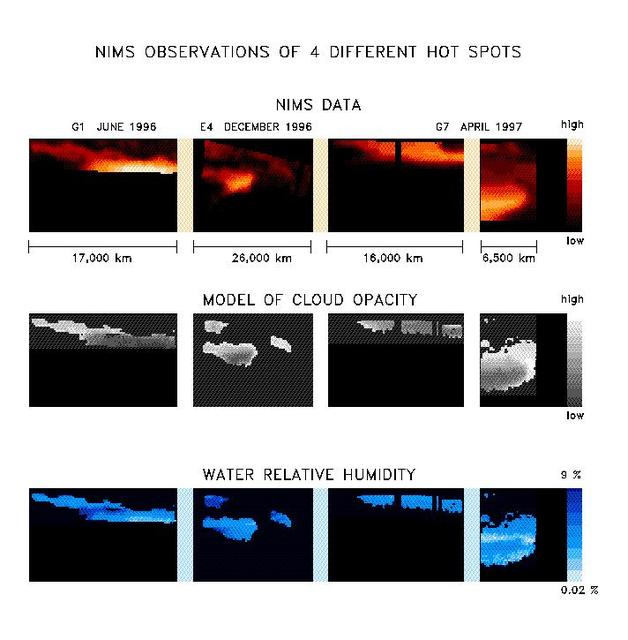
NIMS Observes the Structure and Composition of Jupiter Clouds
With the NIMS instrument high quality observations are being obtained from all parts of Jupiter. The images in the upper panel are taken at a wavelength of 4.8 microns. At this wavelength thermal radiation from about 100 km deep below the visible cloud deck is escaping, allowing us to study the deep atmospheric region. The overlying cloud deck absorbs a part of the radiation, but there are places where it is thin and more radiation can escape. These are called hot spot regions. Many hotspots regions occur in a zone between the equator and 15 degrees north latitude, the North Equatorial Belt (NEB), but thermal radiation is seen from much of the planet. The uniqueness of NIMS is that it is capable of observing the same spatial region at a maximum of 408 different wavelengths between 0.7 and 5.2 micron simultaneously. Every picture element (pixel) contains a spectrum of up to 408 wavelengths. The gases that compose the atmosphere leave there traces in the spectra. In this particular case, 48 wavelengths were available between 4.6 and 5.2 micron, and we see spectral signatures of water, ammonia, and phosphine. Also, the total amount of radiation is determined by the amount of overlying
- Date
- 1998-03-26
- Photographer / author
- NASA/JPL
- Collection
- JPL
- Archive
- NASA Image and Video Library
- Type
- photograph
Public domainsafest
Reason: a NASA work: not copyrighted in the United States.
Read from: NASA media usage guidelines: NASA material is not copyrighted in the US unless noted; no third-party credit or mark found.
Credit line
"NIMS Observes the Structure and Composition of Jupiter Clouds" (1998-03-26). NASA/JPL/NASA/JPL. Public domain. https://images.nasa.gov/details/PIA01224Need photos for a whole script? Add Find Any Photo to Claude and ask for this one by its id: 22143.
More like this
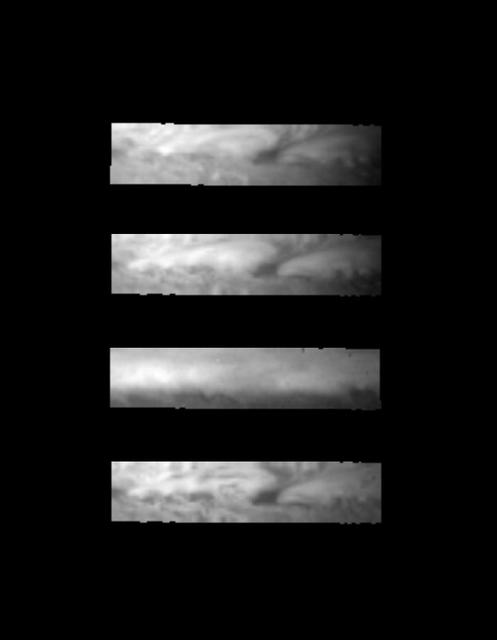
NIMS Views of a Jovian Hot
1998-03-26 · NASA Image and Video Library
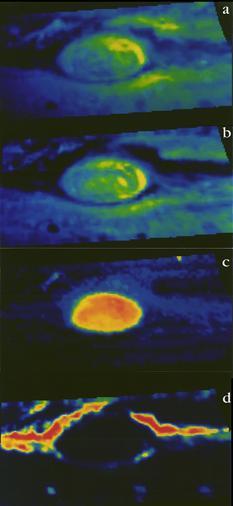
NIMS Spectral Maps of Jupiter Great Red Spot
1998-03-26 · NASA Image and Video Library
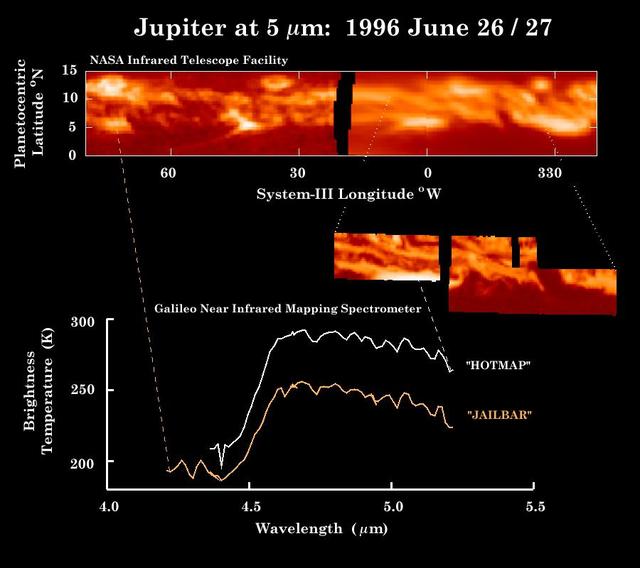
Observations of Jupiter thermal emission made by the Infrared Telescope Facility and the Galileo NIMS instrument
1998-03-26 · NASA Image and Video Library
Jupiter Equatorial Region in a Methane Band Time Set 1
1998-03-06 · NASA Image and Video Library
Mesoscale Waves in Jupiter Atmosphere
1997-09-07 · NASA Image and Video Library

Jupiter Southern Hemisphere in the Near-Infrared Time Set 2
1998-03-26 · NASA Image and Video Library

Jupiter Southern Hemisphere in the Near-Infrared Time Set 3
1998-03-26 · NASA Image and Video Library

Jupiter Equatorial Region in the Near-Infrared Time Set 4
1998-03-06 · NASA Image and Video Library