
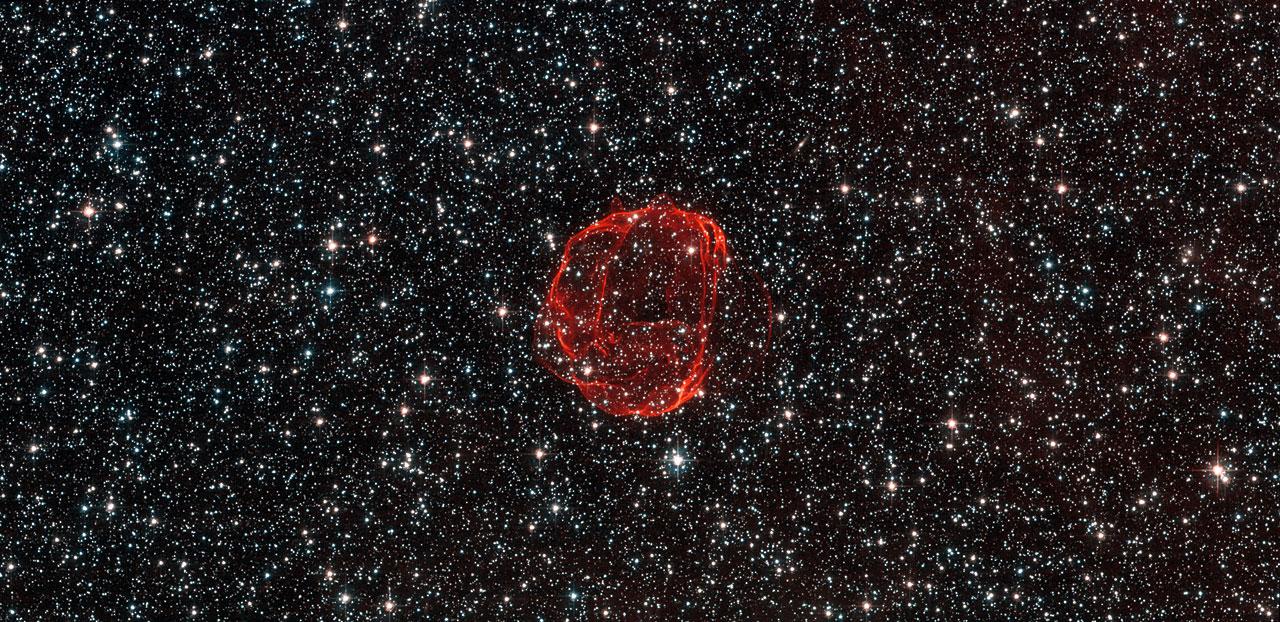
Hubble snap a beautiful supernova explosion some 160,000 light-years from Earth
Of all the varieties of exploding stars, the ones called Type Ia are perhaps the most intriguing. Their predictable brightness lets astronomers measure the expansion of the universe, which led to the discovery of dark energy. Yet the cause of these supernovae remains a mystery. Do they happen when two white dwarf stars collide? Or does a single white dwarf gorge on gases stolen from a companion star until bursting? If the second theory is true, the normal star should survive. Astronomers used NASA's Hubble Space Telescope to search the gauzy remains of a Type Ia supernova in a neighboring galaxy called the Large Magellanic Cloud. They found a sun-like star that showed signs of being associated with the supernova. Further investigations will be needed to learn if this star is truly the culprit behind a white dwarf's fiery demise. This image, taken with NASA's Hubble Space Telescope, shows the supernova remnant SNR 0509-68.7, also known as N103B. It is located 160,000 light-years from Earth in a neighboring galaxy called the Large Magellanic Cloud. N103B resulted from a Type Ia supernova, whose cause remains a mystery. One possibility would leave behind a stellar survivor, and astron
- Date
- 2017-12-08
- Collection
- GSFC
- Archive
- NASA Image and Video Library
- Type
- photograph
Public domainsafest
Reason: a NASA work: not copyrighted in the United States.
Read from: NASA media usage guidelines: NASA material is not copyrighted in the US unless noted; no third-party credit or mark found.
Credit line
"Hubble snap a beautiful supernova explosion some 160,000 light-years from Earth" (2017-12-08). NASA/GSFC. Public domain. https://images.nasa.gov/details/GSFC_20171208_Archive_e000107Need photos for a whole script? Add Find Any Photo to Claude and ask for this one by its id: 17160.
More like this

Hubble Supernova Bubble Resembles Holiday Ornament
2017-12-08 · NASA Image and Video Library
Hubble Sees the Remains of a Star Gone Supernova
2017-12-08 · NASA Image and Video Library
NASA's Hubble Sees A New Supernova Remnant Light Up
2017-12-08 · NASA Image and Video Library

Preview of a Forthcoming Supernova
2017-12-08 · NASA Image and Video Library
Hubble Zooms in on Shrapnel from an Exploded Star
2017-12-08 · NASA Image and Video Library

Hubble Sees a Star Set to Explode
2017-12-08 · NASA Image and Video Library

New Hubble Observations of Supernova 1987A Trace Shock Wave
2017-12-08 · NASA Image and Video Library

Hubble Catches Stellar Exodus in Action
2017-12-08 · NASA Image and Video Library